Thursday, December 30, 2021

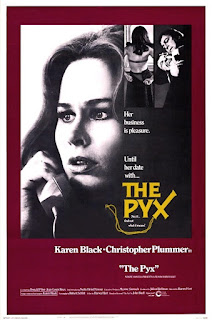
ARTICLE, NOUN I: The Pyx (1973)


The Pyx
 is an obscure movie adapted from an obscure book written in 1959 by an obscure Canadian professor named John Buell. Buell's short (our Crest paperback edition is 128 pages) hardboiled detective story-cum-satanic cult expose is really more of a novella. The task of committing it to celluloid was taken on by director Harvey Hart, a Canadian better known for his work in TV at that point. It's worth noting that Ranting Russell founder Russell Bladh has always had a soft spot in his heart for Harvey Hart, as the Toronto-born director/producer helmed both the 1st-season Star Trek episode Mudd's Women, and the 1st-season Wild Wild West episode The Night of the Dancing Death. With respect to the latter, Mr. Bladh - before he had a breakdown and was committed - always said it contained one of the greatest lines in television history: "Death is your destination. I hope you had a good look." He actually used to say this randomly to staff, walking around the office.

Struck by such a morbidly catchy line, staff went back and watched the episode, discovering guest star Peter Mark Richman actually says "That is your destination" (he's motioning towards a big hole in the floor, through which he intends to throw Robert Conrad). We decided against telling Russell he misunderstood it. Dude had enough on his plate already.

Buell structured his book with The Present and The Past chapters, beginning in The Present, and alternating a total of six times between the story of junky prostitute Elizabeth Lucy getting set up with the mysterious Mr. Keerson, and Lieutenant Henderson's investigation of Lucy's apparent suicide, falling from the top of an 11-story apartment building. Screenwriter Robert Schlitt, who also spent most of his career in television, ran with this structure, upping the ante to give the story more oomph in a visual medium: instead of just six jumps in time, the movie jumps 26 times, and does so fluidly and with a decent amount of tension, thanks to the editing skills of a then-young Ron Wisman.

The Pyx is a great example of filmmakers adapting a book for the silver screen and having zero interest in casting actors even remotely resembling their literary counterparts. This staff positively adores Humphrey Bogart, but remember The Maltese Falcon's killer opening paragraph, where Hammett writes "Samuel Spade's jaw was long and bony... his pale brown hair grew down - from high flat temples - in a point on his forehead. He looked rather pleasantly like a blond Satan," and then they cast Bogie as Sam Spade in the movie, who looks nothing whatsoever like a blond Satan?


Here we have the book describing Lieutenant Henderson 
as "in his fifties, balding and greying, with a tall, heavy, now paunchy body." In the movie Henderson is played by Christopher Plummer, who was 44 at the time, sporting a full head of dark hair, trim and handsome. We grudgingly accept the casting department's decision, as we all love Christopher Plummer. But really...?

Our heroin-addicted heroine is played by Karen Black, just three years after her outstanding turn in Five Easy Pieces, and just a couple of years ahead of her finding Scientology. (Still, Trilogy of Terror wouldn't have been the same without her. - Ed.) Black is outstanding here, lifting up an otherwise prosaic movie with her portrayal of the doomed Elizabeth, who knows something isn't quite copasetic with the john her boss Meg Latimer is setting her up with, but senses it is a very bad situation indeed. Things get weirder when Meg forces her to meet in private with the mysterious Mr. Keerson, played with suitable menace by Jean-Louis Roux, who orders her to disrobe and tell him about her life, all while staring right into her eyes, never ogling her body.


This would already be a wonderfully unpleasant and awkward scene, but director Hart does something interesting here, overlaying the second movement of Bach's Violin Concerto in A Minor (BWV 1041) - and LOUD - over the whole scene in real time. The juxtaposition of one of the most sublimely beautiful pieces of music in history with the evil Keerson psychologically probing naked Elizabeth isn't as unnerving as it should be, but we still give Hart props for trying something wholly unexpected. If you want to see what happens when the perfect piece of classical music is embedded in a movie, check out the POV scene in The Black Cat where Karloff leads Lugosi through the old chart room for long-range guns in the ruins of Fort Marmorus, after showing Lugosi how he's preserved his (Lugosi's) dead wife in an upright glass container. Against the haunting strains of the 2nd movement of Beethoven's 7th Symphony, Karloff delivers an astonishing soliloquy, qualifying for Best Movie Scene No One's Aware Of. Go watch the 1934 Black Cat this instant if you've never seen it.

The upshot to all of this - Keerson hired Elizabeth to be sacrificed in a satanic Black Mass in his penthouse that ends with him tossing her off the top of a high-end apartment building - leads to a final scene that shows you how much potential this little movie had, but just didn't quite deliver on. Lieutenant Henderson tracks Keerson to his penthouse, where the mysterious businessman tells the detective his name isn't Keerson at all. "You know my name. You know it, Henderson. You know it better than anyone. When your wife died in that accident... you were happy. You felt liberated. My name touched you then. You went to confession but it didn't help. You couldn't forget. You didn't want to. You too felt the hypocrisy of the church."

Robert Schlitt's screenplay, serviceable until now, suddenly takes flight here. We discover a heretofore unreferenced catastrophe in Henderson's past (earlier in the film we see Henderson waking up at his girlfriend's apartment, desperate to leave, but no mention of a wife, dead or otherwise), explained with malignant glee by a man who is, apparently, possessed by Satan himself. But Keerson is just warming up: "You keep a little corner of morality inside that stinking soul of yours. A minor delusion to convince yourself that you still know good from evil. But you don't know it, Henderson. You don't know it 'til you touch it. 'Til you open yourself up to the power. When it manifests itself, then you know it. And it's there. It is. It exists. I've seen it. I've become it."

So we find out in the final four minutes of a 111-minute movie that the male lead has a dark secret, and that the villain has a penchant for delightfully evil monologs. We could have used a little more of both during The Pyx's runtime. There was potential here, but the source material was too hesitant to begin with, never doing a true deep-dive into moral depravity and the dark side of the human soul (in a passage from the book that fails spectacularly to convey the vibe of big city crime and despair, Henderson laments the trouble young women like Elizabeth get into, thinking "Mrs. Latimer would want the body, but alive, alive to peddle it, to feed it heroin, to dress it up, to make it entertain lechers who had nothing but money and erotic energy"), and in the final analysis we have to agree with writer John Kenneth Muir: The Pyx just isn't artful enough to make any forceful or memorable point about good and evil, sacrifice and virtue. It doesn't help that parts of the movie (if not all of it) were shot MOS with voices looped in post, lending the film a cheapness it never quite escapes from.

Keerson's spicy soliloquy, incidentally, doesn't appear in the book, and neither does the revelation that Henderson felt relieved when his wife died. In the book Satan appears to be speaking through Keerson and Henderson has to cold-cock him, after which Keerson comes to, yammering semi-coherently ("I can't control it anymore... after she... died it came over me fully, at last, with... I thought I had the power to... it felt as if I was ruling. But it's beyond me now... I can't command... the chaos") before Henderson plugs him.

...And if you're too dull to figure out what went on between Henderson and Keerson in that penultimate scene, "The Secret of The Pyx: A Postscript," by Daniel P. Mannix, is happy to beat you over the head: "The novel you have just read may have left you a bit mystified as to the true character of Keerson and the nature of the rites he intended to perform over the nude body of Elizabeth Lucy. Keerson had become a victim of demoniacal possession and was attempting as a Satanist to perform the terrible ritual of the Black Mass."

Geez, thanks, Mr. Mannix. Damned if I coulda figured that out on my own.

Mannix, incidentally, is the man who wrote Those About to Die in 1958, that Ridley Scott made into Gladiator with Russell Crowe. The movie steers clear of Mannix's asinine postscript and ends depressingly with Henderson standing over Keerson's body.

A pyx, for the Catholic among you, is a locket-like contraption that holds a host.


Tuesday, December 28, 2021

ARTICLE, NOUN: "The" horror movies of the 70s & 80s


At the behest of Ranting Russell Executive Editor Renee Muller, staff will analyze all horror movies from 1970 to 1980 whose titles are simply "The" and one other word. This silly - nay, ridiculous - concept arose two nights ago whilst staff drank a bottle of Four Roses bourbon after-hours that Sheridan Rowan got as a Christmas present from her aunt. Longtime staffer Isabella Stamps ruminated on her love of Tony Curtis and The Manitou, and new staffer Chone Lee chimed in about how underrated 1972's The Asphyx is, and hey, presto! here comes Renee - who already had two beers before diving into the bourbon, I might add, and probably wasn't thinking clearly - pointing out that both movie titles were simply an article and a noun. How many horror movies can you think of that are just "The" and a noun? she challenged us. We half-drunkenly threw out the obvious ones - The Exorcist, The Devils, The Boogens, The Shining, et al. "THAT'S THE NEXT PROJECT," spaketh our inimitable leader. "We will watch ALL horror movies produced within a designated time period whose tiles are 'The' and a noun." And that, sadly, was that.

I hoped Renee would, upon sobering up the next morning, shake her head in that I'm-so-sorry-for-everything-I-said-last-night-when-I-was-drunk kind of way and tell us to forget she had even entertained the idea, but no - if anything, she doubled down, calling all of us before 9am: "I want the 'Article, Noun' list by noon." Hell of a way to begin the new week.

The "designated time period" is 1970 to 1985, and there is no rational reason for that span of time. Renee's love of all things 1970s dictated that we include the whole decade, and one staffer who shall remain nameless threatened to quit unless we all - ALL of us - watched Michael Mann's glorious 1983 disaster The Keep, pushing us into the early 80s. Thus 1985 became the official subjective cut-off year.

As already mentioned, to qualify a movie can only be two words: "The" and a noun. Hence, integral movies such as The Satanic Rites of Dracula and The Evil Dead are automatically disqualified.

Here is the list. No doubt it's incomplete, so please email us with everything we missed:

The Devils (1971)

The Victim (1972)

The Asphyx (1972)

The Cult (1972, AKA The Manson Massacre)

The Fiend (1972, AKA Beware My Brethren)

The Other (1972)

The Baby (1973)

The Bride (1973, AKA Last House on Massacre Street)

The Exorcist (1973)

The Crazies (1973)

The Demons (1973, Jess Franco)

The Pyx (1973)

The Forgotten (1973, AKA Don't Look in the Basement)

The Antichrist (1974)

The Gardener (1974)

The Tenant (1975)

The Ghoul (1975)

The Omen (1976)

The Premonition (1976)

The Keeper (1976)

The Child (1977)

The Sentinel (1977)

The Chosen (1977, AKA Holocaust 2000)

The Uncanny (1977)

The Pack (1977)

The Possessed (1977)

The Psychic (1977, AKA Seven Notes in Black)

The Spell (1977)

The Brute (1977)

The Bees (1978)

The Swarm (1978)

The Legacy (1978)

The Evil (1978)

The Fury (1978)

The Manitou (1978)

The Shout (1978)

The Brood (1979)

The Dark (1979)

The Evictors (1979)

The Visitor (1979)

The Attic (1980)

The Unseen (1980)

The Awakening (1980)

The Shining (1980)

The Babysitter (1980)

The Boogeyman (1980)

The Fog (1980)

The Children (1980)

The Changeling (1980)

The Hearse (1980)

The Alchemist (1981/1983)

The Beyond (1981)

The Boogens (1981)

The Burning (1981)

The Fan (1981)

The Funhouse (1981)

The Hand (1981)

The Howling (1981)

The Nesting (1981)

The Pit (1981)

The Prowler (1981)

The Survivor (1981)

The Aftermath (1982)

The Appointment (1982)

The Clairvoyant (1982)

The Entity (1982)

The Incubus (1982)

The Forest (1982)

The Sender (1982)

The Slayer (1982)

The Thing (1982)

The Hunger (1983)

The Prey (1983)

The Being (1983)

The Lift (1983)

The Keep (1983)

The Initiation (1984)

The Mutilator (1984)

The Game (1984)

The Bride (1985)

The Covenant (1985)

The Strangeness (1985)

The Stuff (1985)

The thought initially was to go in chronological order, but that idea quickly fell by the wayside when staffer Van Bigola found a used copy of The Pyx on DVD at a pawn shop ("It was clearly meant to be," said he), so we'll being with The Pyx and go in whatever order we like after that. Renee wants this project all wrapped up by the end of 2022. Start your timers.

courtesy retrographik.com


Sunday, October 3, 2021

Queen at 50, Part VIII

 Jazz (November 1978)


"One reason why Queen were never taken seriously by the press in the pop world was that they were not leaders of a social movement. They didn't stand for anything, except themselves. In that sense, which is normal in a person's employment, they may have even seemed a bit egocentric." - Paul Gambaccini

*****

It's worth reprinting, in full, the hysterical review of Queen's Jazz that the sanctimonious, grumpy critic Dave Marsh wrote for Rolling Stone in February of 1979:

"There's no Jazz on Queen's new record, in case fans of either were worried about the defilement of an icon. Queen hasn't the imagination to play jazz - Queen hasn't the imagination, for that matter, to play rock & roll. Jazz is just more of the same dull pastiche that's dominated all of this British supergroup's work: tight guitar/bass/drums heavy-metal cliches, light-classical pianistics, four-part harmonies that make the Four Freshman sound funky and Freddie Mercury's throat-scratching lead vocals.

"Anyway, it shouldn't be surprising that Queen calls its album 'jazz.' The guiding principle of these arrogant brats seems to be that anything Freddie & Company want, Freddie & Company get. What's most disconcerting about their arrogance is that it's so unfounded: Led Zeppelin may be as ruthless as medieval aristocrats, but at least Jimmy Page has an original electronic approach that earns his band some of its elitist notions. The only thing Queen does better than anyone else is express contempt.

"Take the LP's opening song, 'Mustapha.' It begins with a parody of a muezzin's shriek and dissolves into an approximation of Arabic music. This is part of Queen's grand design. Freddie Mercury is worldly and sophisticated, a man who knows what the muezzin sounds like. More to the point, you don't. What trips the group up, as usual, is the music. 'Mustapha' is merely a clumsy and pretentious rewrite of 'Hernando's Hideaway,' which has about as much to do with Middle Eastern culture as street-corner souvlaki.

"But it's easy to ascribe too much ambition to Queen. 'Fat Bottomed Girls' isn't sexist - it regards women not as sex objects but as objects, period (the way the band regards people in general). When Mercury chants, in 'Let Me Entertain You,' about selling his body and his willingness to use any device to thrill an audience, he isn't talking about a sacrifice for his art. He's just confessing his shamelessness, mostly because he's too much of a boor to feel stupid about it.

"Whatever its claims, Queen isn't here just to entertain. This group has come to make it clear exactly who is superior and who is inferior. Its anthem, 'We Will Rock You,' is a marching order: you will not rock us, we will rock you. Indeed, Queen may be the first truly fascist rock band. The whole thing makes me wonder why anyone would indulge these creeps and their polluting ideas."

*****

Describing his days as a young man working at Creem magazine, Dave Marsh said "I had a vision for what the magazine could do for kids who were out there being ridiculed, and beat up, and all that shit. The idea I had about Creem was, that even in rock'n'roll, it had come to pass that there was a stuffy ways of dealing with people. And I thought that part of your job as a human being was to oppose that. And if it meant that you bled a little for it, so what? Because there's some other kids who's gonna read this thing and be freed by it."

Apparently it never crossed Marsh's simplistic mind that there were many gay kids getting ridiculed and beat up for being effeminate in the 70s who loved Queen because of their effeminate lead singer. I'd bet good money many of them would tell you they were freed by the band's music. It also apparently never crossed his mind just how stuffy he was being when he trashed all the bands he hated in print and in interviews.

Why, it is logical to ask, does a man who hates so much music get paid to write about music? Because in a capitalist set-up, even miscreants and malcontents like Dave Marsh can throw their bitterness and bile at the wall and see if it sticks. That Creem and Rolling Stone flourished (for a time) printing nonsense like Marsh's Jazz review just shows you how many other bitter, close-minded people there are in the world who enjoy (or think they do) reading total junk. "Fascist rock band?" I'm not sure anything quite as idiotic has ever been written in an album review.


Fast forward 20 years and magazines like Q, Uncut, Mojo, Classic Rock, and yes, Rolling Stone, regularly lavish praise on Queen, and even Jazz. This is an approach that makes sense: find people who actually like the bands to write reviews of the records. Because there's nothing whatsoever to be gained by criticism that savages the subject, whether it's an album, book, or movie. All art is valid. Every last bit of it. Personally, I can't stand Journey or Billy Joel, but they are outstanding musicians and their music is loved by millions. I am, therefore, the last person who should be writing a review about any of their records. It's the people who dig Journey and Billy Joel who should review their records. There's plenty to be gained by hearing about why they love it, why old fans would like or dislike the new album, and why newcomers should give it a listen. Tearing down a band and their music just because you - one of eight billion motherfuckers on this planet, none of whom is more important than another - don't like it accomplishes absolutely nothing. If anything it takes us back a few steps, and it makes you sound like a whining, obnoxious crank. Negativity lowers the quality of life for everyone. I'm tired of a low quality of life. We all deserve better.

Unquestionably, Jazz is "pretentious" and Queen were frequently "arrogant." But anyone who makes that their main sticking point, in an industry brimming over with the likes of Elton John, Bob Dylan, Gene Simmons, Paul Hewson, Prince, and Mick Jagger, is taking himself way, way too seriously and ought to find another line of work.

As for the album: Dead On Time rocks, and rocks very, very hard. It is one of the all-time great Queen songs, and is so frantic and crazed you expect it to careen off the tracks at any moment. The main riff for the verses sounds like Brian May is making it up as he goes, just trying to keep up with the rhythm section. Some interesting trivia: Brian May lifted Dead On Time's out-of-hand chorus from the so-called "Fast" version of We Will Rock You, originally recorded in October of 1977 for the BBC. For years afterwards Queen opened their shows with We Will Rock You (Fast), but most fans - especially those in the U.S. who weren't able to listen to the BBC - never realized that May took Rock You (Fast)'s chorus, bumped it up a full step from E to G-flat, and reconfigured it for Dead On Time. And no jury would convict him. Dead On Time is right up there with Sheer Heart Attack and Death On Two Legs. Turn the volume way up and see what life has to offer.

Mustapha, incidentally, is hardly a clumsy and pretentious rewrite of Hernando's Hideaway. It's a fiery album-opener, waiting a full minute and nineteen seconds before the bass and low end storm into the mix (nice touch, that), making you scramble to turn the volume down so your speakers don't blow. Or, if you're smart, you just leave the volume up, speakers be damned. What's not to love? Life is short. Take advantage of the good things.

May's Dreamers Ball (minus the possessive apostrophe) is the perfect song for sitting on your porch on a summer night with a glass of bourbon, gazing at the moon with the lights out, just blending into the dark, all by yourself, existing perfectly in the moment. John Deacon meets the moment with some fine bass playing, and Freddie channels his inner lounge singer even better than he did a year earlier in My Melancholy Blues.

Mercury sings In Only Seven Days with more feeling than this short filler track probably deserves. The singer's unwavering dedication to his craft saves the song from its forgettable lyrics ("gratingly naive," according to Georg Purvis). This is what you'd call "serviceable" John Deacon.

As always, May singing one of his own songs adds another layer of texture to an album awash in different textures. Leaving Home Ain't Easy is filler, but it's elegant filler, all acoustic with no solo - one of those rare instances before the synthesizer years where the Red Special is nowhere to be heard. The guitarist sneaks in one painfully sarcastic lyric (I'm a happy man, don't it look that way?), and hearing Freddie's voice peaking over some of the backing vocals is a beautiful thing.

Roger Taylor is not quite up to his usual form on this record. The drummer, who contributed two of the most stunning songs in Queen's oeuvre on News of the World, shows up here with More of that Jazz and Fun It. More of that Jazz isn't A-list stuff, yet over the years I've grown closer to its lyrics, neatly conjuring up the kind of crippling ennui that can take you out if you're not careful, and the chorus' chord progression is freakin' awesome, you have to admit. C'mon, E to A-flat to E-flat to G? With a pick scratch in there? Even when he's not firing on all cylinders this guy's got something worth your time. Probably he played all the instruments again, as he did on News of the World. And people say Freddie had a huge ego?


Fun It is officially Queen's First Foray Into Disco. Casual Queen fans might think it was Deacon's Another One Bites the Dust, but no, it was Roger Taylor, bad-boy drummer extraordinaire, the man who wrote Modern Times Rock and Roll and Sheer Heart Attack, who first got all funky on a Queen album, ponying up three and-a-half minutes of disco-tinged, ass-shaking danciness along with some dubious lyrics ("fun's for free," etc.). There's nothing to love here, but I tell ya, there's no way to hate it, either. How can you? It's just kind of odd and harmless. For better or worse, it probably planted the seed for Another One Bites the Dust, giving the band a massive world-wide hit two years later.

I always enjoy reading what Queen fanboys have to say about Deacon's If You Can't Beat Them. Characterizing it as a "snarling rocker" and "vicious" are two faves. Don't be fooled - it is neither. It is a decent enough pop/rock song sabotaged by juvenile, insipid lyrics that I can't even believe Freddie agreed to sing. Here are the cliches Freddie sings without a hint of facetiousness: "keep your chin up," "don't let them get you down," "give as good as you get," "I'll play you at your own game," and of course, the title itself. And yet, under the "Plays" column in my Apple Music, this song registers a hefty 46. This is solely because at the 3:03 mark, with one minute and twelve seconds to go, the band roars to a halt and then blasts into an outro based on the verses that is enormous fun. Roger Taylor giddily beats his drums up, Brian May puts some phase on his Red Special, and a previously silly filler song transmogrifies before your very ears into a seriously joyous romp. This is what great bands in their prime are capable of: taking 2nd or 3rd tier songs and injecting them with something that still makes them worth your while. I can listen to those final 72 seconds all day long.

Freddie deftly borrows a chord progression from Lily of the Valley in Jealousy, an overlooked song that is the third song on side one and yet was never performed live by the band. Listen to the lead-in to the chorus ("You couldn't lose you couldn't fail, you had suspicion on my trail") and then listen to the bit in Lily of the Valley where Freddie sings "I lie and wait with open eyes, I carry on through stormy skies." Different keys, but Lily's chord pattern and melody are embedded within Jealousy's more complicated structure. And it really is gloriously complicated: what seems at first pass like a straightforward ballad about love and loss is rife with sharps, sixths, sevenths, diminished chords and unorthodox ascending patterns, while the verses change gears halfway through their arrangement each time, dropping from F to E flat. John Deacon's bass playing is typically brilliant. You know those movies or books you love that only a very small cadre of people are aware of, and you feel like you're a member of some secret, superior club? Jealousy is a song that only Queen fans know and we like it that way. In an incident reflecting the perils of the transition from the analog to the digital age, when Hollywood Records issued the entire Queen catalog on CD in 1991, the kick drum was nowhere to be heard on Jealousy. It was successfully restored in 2011 on the remastered Jazz.

The band wisely used Let Me Entertain You as a blunt instrument at the top of their setlist for a few tours in the late 1970s. It absolutely rocks, and is so wonderfully Freddie that it sums the man up - at least how he approached playing concerts - in just three minutes. Wanna know what kind of a show this shy man from Zanzibar thought bands should give their fans who paid a premium for concert tickets? He actually turns Cruella de Vil into a verb: "I'll pull you and I'll pill you, Crueladaville you, and to thrill you I'll use any device..." As part of the entertainment package he even offers "grounds for divorce." Great fucking lyric. And Brian May reliably adds his indelible signature with some frenzied leads and a good helping of feedback, like just the perfect amount of garlic in a tasty stew. Don't ever let anyone tell you this isn't one of the great Freddie songs.

Another great Freddie song is Don't Stop Me Now, the album's second single, that broke the top 10 in England but didn't do much at all in the U.S. If you're a member of the rock band Queen, perusing the American charts in January 1979, not seeing your latest single in the top 20, this is extremely disappointing. Don't Stop Me Now is one of the great party songs of all time, right up there with Highway to Hell, Celebrate and Let's Go Crazy. How many instantly-singable songs did this guy have sitting around his living room back then? And again: Brian May's lead is straight-up rollicking greatness. Are you familiar with the quote attributed to Michelangelo about how he created his masterpiece, David? "You just chip away the stone that doesn't look like David." May's genius followed a similar path between 1974 and 1980. Hearing those songs from that classic era as a kid, every guitar solo seemed so obvious - not predictable, but so obviously perfect within the structure of each song. Even at that young age I would think, of course, this amazing guitar solo, it makes perfect sense. How could these beautiful notes not be in this song? Brian just got rid of all the extraneous notes obscuring everyone's pathway to bliss, and brought out the notes that should be there - that had to be there -  for all of us to absorb. It was enough to make me believe that there really was order in the cosmos.

Jazz's first single was the double A-side Bicycle Race/Fat Bottomed Girls, generating what was then familiar animosity from so-called rock critics. "They deserve all the vitriol that may be further hurled at them," spaketh the New Musical Express, "if this is an accurate preview of the new album." But of course no vitriol whatsoever is warranted. I know Bicycle Race seems authentically ridiculous: that insane chorus bafflingly hammering home Freddie's desire to ride his bicycle, and the annoying bit in the middle with bicycle bells - dumbass stuff, yeah? But such silliness belies the only political song Freddie ever wrote, wherein he takes potshots at Jaws and Star Wars, disparages LBJ and Nixon, and then blasphemes twice, comparing God to make-believe characters like Frankenstein (we're sure he meant "Frankenstein's monster," but give the man some poetic license) and Peter Pan. Woo hoo! This is our kind of song. And thanks to the wonderful geniuses at Hollywood Records, you can listen to the backing track sans vocals on the 2011 Jazz remaster. "They deserve all the vitriol that may be further hurled at them?" What are you, fucking stupid? Listen to the rhythm section during the verses. This is not an easy song to play, and these guys are playing their asses off. It stands to reason that it was no less difficult to write. But hey, why take the time to really listen to a song and understand it when you can take all of three minutes trashing it in a childish review and get paid for it?

When the writer of a song himself is dismissive of his creation, as Brian May is with Fat Bottomed Girls ("I thought [it] was okay, but fairly banal") it is tempting to take the Dave Marsh road to derision and ridicule and total negativity and write the whole thing off. But don't listen to Brian. The guitarist is just being modest. Fat Bottomed Girls is great, guitar-driven rock and roll, and it is still a joy, all these years later, basking in the glow of its D-major dirgeyness, listening to May take his time riffing all over his drop D tuning from beginning to end. It's worth noting the definitive version of this song is on Queen On Fire: Live at the Bowl, where a robust production brings out the low ends and kick drum and is a very good thing to listen to very, very loud.

Which brings us to the one aspect of Jazz that truly is deserving of criticism. If anything actually sucks here, it's the production. Queen roped Roy Thomas Baker back into the fold for Jazz, and alas, their old-time producer, whose sharp ear gave their first four albums such depth and solid grounding, was fresh off his stint producing The Cars' debut album. Filled with loony notions of stripped-down new wave sparseness, Baker declawed Roger Taylor's big, meaty drum sound, a hallmark of every Queen album up until Jazz. The result is an album whose great songs sound only about 70% as good as they should have, leaving everything with a very un-Queen-like, tinny, trebly sheen.

Queen took a year off before recording their next studio album, filling the void with a live album. By the time The Game appeared in June 1980, the band made some major changes, bringing the curtain down on their classic era.


Thursday, December 31, 2020

Queen at 49, Part VII

 News of the World (October 1977)


Here's some boring, forensic information about Queen's sixth album: it's entitled News of the World. It was recorded in 1977, between July and September, and released in October of that same year. It was the second album in a row the band produced by themselves in conjunction with engineer Mike Stone and was mostly recorded at Wessex Sound Studios in London, but also in West London's Basing Street Studios. The cover was painted by famed Sci Fi artist Frank Kelly Freas and is based on the cover he painted for the October 1953 issue of Astounding Science Fiction. There are eleven songs on the album, with all four band members writing at least two each.

Now here's all you need to know about News of the World: it is Queen's greatest album. It was better than everything that came before it, and they'd never record anything this good again. A Night at the Opera and A Day at the Races are outstanding, containing some of their finest songs. Any other band releasing records that good could never record another note and retire happily, knowing they'd left their mark on popular culture.

But News of the World contain's Queen's two greatest anthems, their heaviest song, and a finalist for Greatest Queen Song of All Time, among other gems. The album's misfires - and there are three of them - do not alter the fact that six songs here easily qualify as top-tier Queen songs, some of the best work the band ever did, and among the best the 70s had to offer.

Music magazine writers never miss an opportunity to remind everyone that News of the World must always be viewed through the lens of the rise of Punk Rock. It was, of course, Queen for whom the Sex Pistols substituted on December 1, 1976, when they cursed on live television, precipitating a cultural uproar. And, as been written about innumerable times, the Sex Pistols were also at Wessex Studios in 1977, recording Never Mind the Bollocks as Queen recorded NOTW. Whether or not Queen had already decided to record something more basic on their own or felt pressured by Punk's encroachment depends on which member of the band you talk to, and what year. Roger Taylor, in 1978: "Our music has got much simpler recently, really, despite what people may think. In terms of studio use and recording techniques 'We Are the Champions' is the most simple track in the charts at the moment." Brian May, in 2017: "We'd already made a decision that... [after] A Night at the Opera and A Day at the Races, we wanted to go back to basics for News of the World." Roger Taylor, around 2010: "We couldn't reinvent ourselves as a punk band, but we wanted it a little bit more simple... To be more of the times, I guess we made a more straightforward record."

Not frequently mentioned in discussions about NOTW is that two albums after dropping Roy Thomas Baker as their producer, the band proved as capable in the control room as they were playing their instruments (with an invaluable assist from Mike Stone). As well as being their best album, NOTW is Queen's best sounding album. The rhythm section in particular never sounded as glorious as it does on NOTW. Roger Taylor's kick and snare are beautifully full and earthy. John Deacon's bass tone has the perfect amount of bite. Having set aside millions of vocal and guitar overdubs for the moment, Queen sounded like a straight-up rock band.

Sleeping on the Sidewalk is one of the most forgettable songs in the band's catalog. Queen were never a blues band, and why Brian May thought attempting another blues number was a grand idea, four years after having ripped off Sonny Terry and Brownie McGhee with See What a Fool I've Been, is a mystery. The Latin American vibe conjured up by John Deacon's Who Needs You should be a lot more memorable than it is. Even a nifty acoustic guitar lead (presumabley played by May, although Deacon plays acoustic guitar on the track) doesn't save the song from its undistinguished-ness. Freddie's My Melancholy Blues amusingly evokes a smoky lounge and can even be kind of cathartic if you're drinking alone at home late at night. The singer liked his album-closer enough to record it during one of the band's BBC sessions (dig Brian May's solo on the BBC take!) and keep it in the set during the band's 1977 tour. It sounds much better live.

All Dead, All Dead is a bit overwrought, and ventures perilously deep into old-time, epically-overdubbed Queen circa Queen II at the 1:55 mark, but is more than redeemed by some great lyrics in the final verse and chorus, and some beautiful Beatles-esque harmonies throughout. Written at least partially about Brian May's recently deceased cat, it is one of the biggest downers the band ever recorded.

A pretty ballad that featured in three straight Queen tours, Deacon's Spread Your Wings  benefits enormously from the fact that the bassist happened to play in the same band as Brian May and Freddie Mercury. Freddie's vocals give the verses with much-needed verve, and May, as he did on You're My Best Friend, spices things up with simple but tastefully tuneful leads. During a BBC session recorded the day NOTW was released, the band taped an even better version of the song, with Taylor doubling the tempo in the outro. It's exhilarating stuff.  Why in hell didn't they do this on the album version?

Freddie's Get Down, Make Love is ridiculous and indispensable. It's been called funk-metal and the freak-out middle section has been called psychedelic, but what astonishes - aside from Mercury's hilarious, intentionally over-the-top lyrics - is the musicianship. With all sorts of space in which to stretch out during the staccato stop-start verses (a rarity in the Queen catalog), Freddie's bandmates rise to the occasion, each adding key flavoring and tension to a song that should be way more popular than it is. Taylor's fills, alternating between snare and roto-toms, snap your head like a whip, sometimes slow and heavy, sometimes fast and cracking, always keeping you suitably off kilter (16 of them - 0:11, 0:19, 0:25, 0:32, 0:46, 0:59, 1:23, 1:30, 1:37, 1:43, 1:50, 2:03, 2:10, 3:18, 3:24, and a superb fill at 1:56). Brian May's feedback sets the mood early from 0:03 to 0:11, and some perfectly placed power chords beef up the song at 0:50, 0:55, 1:52, 1:55, 2:11, 2:14, and 3.26. He also adds precision menace at 0:12, 0:26, 0:29, 0:36, 0:46, 1:24, 1:43, 1:46, 2:04, and 3:20.

But all of this would be academic without John Deacon's inspired work. You can trace the "funk-metal" label directly to the colossal fills he delivers at 0:31, 0:41, 0:48, 1:25, 1:39, 1:49, and 3:23.

Finally, there's Freddie, in total command of this magnificent aberration, sleazy vocals to the fore ("I suck your mind - you blow my head," etc.), mirrored by some impeccable piano playing (1:40). If you ever doubted the band's genius, listen to what happens at the end of the third and final verse. Instead of clipping it off and heading into the chorus with a drum fill, as happens the previous two times, May Plays over Taylor's fill, dropping to A flat (the song is in the unorthodox key of E flat), falling almost grudgingly a step down to G flat, and then up a half-step to G for the chorus. A flat, G flat, and G, all in a row. The effect is heavy and even momentarily disorienting (did these guys just change keys? No, wait...). It doesn't get much better than this, kids.

Taylor's Fight from the Inside - the 1st of two tracks that are essentially Roger Taylor solo songs on NOTW, both of which address teen angst and disaffection - continues in the funk-metal vein, another bass-heavy, borderline sinister song. The bass and guitar are about as nasty as you'll find in Queen's recorded output (guitarist Slash cites it as a fave), and Taylor's lyrics may fairly be described as political, what with his writing off the unnamed teenage protagonist as a "money-spinner tool." The only thing the drummer did wrong in an otherwise perfect song is a misstep in the chorus. It starts going from E flat to F twice, then switching to B flat to F. He should've switched back to E flat/F one more time when he sings "you can't win with your hands tied," for maximum effect. The entire Ranting Russell staff strongly recommends that he re-record the song with this change.

Queen take their genius another order higher with Taylor's other composition on NOTW, Sheer Heart Attack. This is one of those rare moments when all the best pieces of the universe fall miraculously into place for one fleeting instance and you're reminded that life really is a gift. Begun in 1974 but not finished and recorded until 1977, it is the most punk rock song ever recorded by a non-punk rock band and is right up there with the best songs recorded by The Sex Pistols, The Damned, and The Clash. It is a pile-driving tour-de-force. It erupts in your face with a squeal from Brian May's Red Special, assaulting your skull relentlessly over its entire three minutes and 28 seconds. Taylor accentuates the assault with explosive crashes at 1:29, 1:37, 1:45, 2:08, and 2:20, the last leading into May's "solo," twenty seconds of excruciating, high-pitched NOISE (don't believe me? Listen to it all the way through on high volume. It hurts). played over a single, pounding bar chord that is mercifully squelched by Taylor's propulsive drumming, taking us back to a final, crazed chorus that ends in an instant, falling off a cliff. No outro, no fade. Just over. For the essence of teen angst, look no further than Freddie singing "I feel so inarticulate" at the end of each chorus.

"As years have passed," Chuck Eddy wrote in 2009, "News of the World has come to be best known as The Album With 'We Will Rock You' And 'We Are The Champions' On It." This is an unfair appraisal, given all the other great songs on this record, but the We Are the Champions/We Will Rock You double A-side single remains a worldwide phenomenon 43 years after it stormed the charts, with both songs played in every soccer, football, basketball, and baseball stadium in every nook and cranny of planet earth on a daily basis. Critics - especially contemporaneous critics - delighted in pedantically heaping scorn on the songs, begging the question: do music critics actually like music? We Are the Champions is one of the most deliriously tuneful things I've ever heard. It's the ultimate pop song - you can sing along to it the first time you hear it. The choruses are epic. I lose myself in every note Brian May plays on this track. Yes, the lyrics are arrogant and pretentious. (Like there's not a lot of that in rock'n'roll music.) It's Freddie Mercury, for Pete's sake. Why get worked up about the small things?

And true genius is May's work at the end of We Will Rock You. Listen closely: when the guitar feedback comes in at 1:21, it's in E. But when he hits that gargantuan first chord at the end of the final chorus, it's a C. But when the solo proper begins at 1:35, it's in A. Dr. May fools you twice. Bloody brilliant.

But not quite as brilliant as It's Late, the final Six-Minutes-Plus, Lots-Of-Parts tune of Queen's career. Built around three "scenes" in a love life fraught with peril, It's Late's lyrics are familiar territory for Queen fans. The music, however, is as electrifying as anything recorded within a radius of 20 years. With John Deacon and Roger Taylor locked in as tight as any rhythm section could ever hope to be, the song builds ruthlessly, sporting two sections where Taylor doubles the tempo, driving the song into a fever pitch, and Brian May schools every other guitarist on the planet from beginning to end. This was the guitarist's only significant foray into the hammer-ons favored by Metal guitarists, but he eschews the million-miles-an-hour solos championed by the likes of Eddie Van Halen and Yngwie Malmsteen, instead playing very deliberately, bending almost every note into position, ratcheting up the tension by making a lot of it sound almost out of tune. After two key changes Taylor doubles the tempo, and some out of left-field chord changes and a titanic drum fill take us back to one last verse and chorus. Moving back to the song's original tempo after the frenetic guitar leads is almost gleefully sadistic on the band's part (see additional kick drum beat at 4:41), but right when the song appears to be over at 5:50, another furious Taylor fill starts an explosive outro, culminating in a crazed one-chord bludgeoning that ends the song.

Two years after owning the #1 spot for nine weeks with one of the most complex, overdubbed songs ever recorded, Queen stripped down their sound and recorded their best album. NOTW was a worldwide hit, and broke them in America, the dream of every British rock band. There was no need to issue statements slagging off all the smug, self-important music critics that relentlessly castigated them in print, no need to ask them point blank, whaddya think now, creep? The last laugh was always theirs: Queen simply couldn't help putting out hit records and being wildly popular. All that was left to do was top the charts with an album that was even more offensive to the critics who hated them.


Friday, May 29, 2020

It's Time to Reconsider... the Gor films

Editor’s note: In this edition of “It’s Time to Reconsider…,” longtime Ranting Russell contributor Nolk Landen reassesses the two movies made from John Norman’s Gor novels, 1987’s “Gor,” and 1989’s “Outlaw of Gor” (aka “Gor II”).

*****

Hello Renee –

I got your email assigning me to write about Gor and Outlaw of Gor for the blog’s “It’s Time to Reconsider…” column. I had to cancel a job interview in Lamesa today so I could meet your deadline for the piece. Thanks.

I think I mentioned offhand one night recently, after I’d had five or six margaritas, that none of Urbano Barberini’s dialog in the Gor movies could possibly have been dubbed because his voice was so unbelievably grating, and now somehow I’m an expert, tasked with reappraising the movie and its sequel? Great. I saw the first movie once, upon its release in 1987 when I lived in Dubuque. The boxcar hobo behind me offered up his flask when the lights dimmed and then threw up on himself during the scene where Oliver Reed says, “it will give you the chance of experiencing the delight of giving pain.” My date that night was not impressed. She never talked to me again. The next day my car threw a rod and I was out $1,000. Not that the movie was responsible, it just brings back terrible memories, you know?

At any rate, there’s no “reconsidering” here. You can’t “reconsider” that which warranted no consideration in the first place. There’s a reason Gor has no fans. There’s a reason too that fans of the original novel by John Norman were unhappy with this low budget calamity. In fact, now that I think about it, there’s a reason Gor and its sequel haven’t been released on DVD, much less Blu-ray. No one would buy them. There is no fan base. There is no one dying to play the commentary track and listen to anyone associated with these movies discuss their memories of making it.

Adding insult to injury, this is Rebecca Ferratti post-breast implants. As you’ll recall, Rebecca Ferratti was born in Helena, MT on November 27, 1964, and is of French, Hispanic, and German descent. She was Playboy’s Playmate of the Month in June, 1986, and her turn-ons are positive people, busy days, fresh air, nature, and strong-minded men like her dad. If you can get past the ghastly 80s hairdo she had back then, Rebecca was quite an attractive young woman. But then came breast implants, her role as Talena in the Gor movies, and Mötley Crüe videos, and she was forever dead to me.

So there’s nothing to “reconsider.” In fact, if you want a scene that singlehandedly sums up the Gor cinematic experience, look no further than the opening minutes of Gor, when Tarl Cabot (played by Italian hunk Urbano Barberini) is driving through the rain at night, forlorn that his ladylove isn’t joining him for a weekend in the woods. He crashes into a tree, and the explosion (why would there be a small explosion in the first place?) seems to occur a little to the right of his car, almost on the other side of the tree, away from the car itself. Pathetic.

The rest of the movie is like a waking nightmare. Talena’s father, the King, has been kidnapped by the malevolent priest-king Sarn, played here by a how-the-fuck-did-they-get-him-to-appear-in-this-piece-of-garbage? Oliver Reed. Cabot joins forces with Ferratti and her cohorts, and they set out to rescue him. Along the way, their adventures in Gor are few and agonizingly far between. That whole bit where Cabot and co. sit down for some entertainment in the bar-in-a-cave goes on for over ten goddamn minutes. The music is total shit and it’s painful watching Paul Smith slumming here as the vicious Surbus, his role as Bluto in Robert Altman’s Popeye (1980) notwithstanding. So what exactly do you want me to “reconsider?” The Ranting Russell staff loves bar scenes. We discuss them frequently. Have you noticed Gor never comes up?

There’s that scene towards the end of the picture where Cabot is about to brand Talena with a hot iron and instead turns on Oliver Reed and shoves the iron into his gut, triggering the big fight scene, and Reed bellows “SEIZE HIM!” a few times and then finally thrusts both arms into the air and screams “AAAARRRHHHH!!!!!” I mean, that’s one of those things you’re watching that you can’t believe you’re watching. Barberini and Ferratti are totally surrounded by two-dozen men with big, cardboard swords but somehow no one is up to the challenge of stopping them. What is this, fucking amateur hour? Reed does nothing. He stands almost inert, screaming hysterically. It looks like if he moves too quickly his hemorrhoids will explode.

This should be game set and match. After more than an hour of this, you’re thinking, lovely, the climactic battle scene is finally over, so maybe the credits will roll now, and I can go smoke some heroin, but no: endless scenes of escaping through the underground caves, and they’re caught again, so sadistic Oliver Reed – sans any wound to his belly, where Urbano Barberini just shoved a molten-hot poker a few minutes before – can throw them all into a pit of fire. This farcical scene warrants the only complement I can think of for this movie: its requisite throwing-the-good-guys-into-a-pit-of-death-in-a-low-budget-swords-and-sorcery scene is much better than a similar scene in Joe D’Amato’s Ator II: The Blade Master. D’Amato gave us sparse sets and pit of lethargic snakes. Gor director Fritz Kiersch (whom I grudgingly love for Tuff Turf) gives us FIRE in a pleasant, outdoor setting. Kind of gives it a hint of gritty realism.

Outlaw of Gor is currently only available as an episode of Mystery Science Theater, which is very, very appropriate. A standalone release of this movie would be an enormous waste of the studio’s – and the public’s – time. C’mon, this thing was filmed concurrently with Gor, and yet producer/vice-king Harry Alan Towers had the temerity to sack Kiersch, replacing him with John “Bud” Cardos, (Kingdom of the Spiders, The Day Time Ended), for the sequel, thereby throwing a wrench in the works (“The two leads,” Cardos told Daniel Griffith, “they kinda got married to the first director… We had a little differences there for quite a while”). Who’s to say it wouldn’t have been a better picture had Kiersch stayed on?

Pay close attention to Urbano Barberini at the beginning of the movie when he and Russel Savadier first arrive on Gor. Barberini seems oddly out of sorts for someone who made the role of Tarl Cabot his own a few weeks earlier when the first movie filmed. Chalk it up to the directorial switch?

Much ink has been spilled over Savadier’s bizarre behavior during this scene, but it bears repeating: he says “Cabot” 27 times within 2 minutes and 3 seconds. Transcript:

“Cabot. Cabot. Cabot – Cabot, are you ok? Cabot, speak to me. Cabot. Cabot, are you alright? Cabot, what the hell’s going on? Where the hell’s the car? Cabot?” After Cabot explains they’re on the planet Gor: “Listen Cabot, what are you talking about? Where the hell are we? What’s going on here, Cabot? Cabot, will you explain this to me? … Cabot, listen. Listen to me. Cabot, what’s going on here. What happened last night? Did I do something? What’s going on here, Cabot? Cabot, listen, would you speak to me? I wanna go home right now, alright Cabot? What – where are you going? No no, wait there Cabot. Tell me what the hell’s going on here… Cabot… Cabot, would you wait up? … Cabot, wait – hold on. Cabot, can we take a break? Cabot, I – it, it’s getting hot. Have you noticed? It’s getting warm. Cabot. Cabot. Cabot, can – can we just hold it a minute?"

Elsewhere, an extra playing one of the queen’s guards is clearly asleep in one scene, a car rides through the background in another scene, the cast walks around a 7-foot tall statue of an erect penis at one point, and you can see an extra hiding behind the queen’s outdoor throne near the end. Two arch-villain über-clichés are deployed, one by Jack Palance (“That old fool, the elder – he would dare to meddle in my affairs?”), and one by Donna Denton, as the Queen Lara (“Guards! Seize him!”). Remember that Oliver Reed already screamed “Seize him!” in the first Gor movie. But hey, kudos to Ms. Denton for delivering the most memorable line of either movie with considerable gusto: “Get out of here, you – disgusting – WORM.”

Also, both movies boast the worst fight scenes of all time. Truly. We've moved beyond amateur here – I’ve seen better and more realistic choreography on an elementary school playground.

Carl Panzram once wrote, “the only thanks you or your kind will ever get from me for your efforts on my behalf is that I wish you all had one neck and that I had my hands on it…”

This sums up my feelings towards everyone involved with the Gor films perfectly.


Saturday, May 16, 2020

Queen at 49, Part VI

A DAY AT THE RACES (December 1976)

One could reasonably argue that the apex of Queen’s toxic relationship with the music press was the period between September 11, 1976 and June 18, 1977.

September of '76 saw the New Musical Express’ Phil McNeill unleash a truly impressive array of insults in an article reviewing Queen’s performance that summer at the Edinburgh Festival, contemptuously taking them to task for everything from Brighton Rock (“meaningless exercise”) to Death On Two Legs (“self-righteous... unflinching immaturity...”) to Flick of the Wrist (“a treasure trove of superficialities”) to A Night at the Opera as a whole (“heavy-handed idiocy”) to even the medley the band did every night (a “garish, posturing event”). Odd that he accused the band of self-righteousness, when his article is self-righteousness writ large. Irony on a base level, as the late Bill Hicks would say.

June of '77 saw NME’s Tony Stewart being a total creep to Freddie under the belligerent headline, “Is This Man a Prat?” After conceding he didn’t request the interview to play nice (“the confrontation undoubtedly started with some mutual hostility”), Stewart seemingly enjoys being rude and insufferable to the singer for as long as Freddie will take it. He taunts. He baits. He criticizes Queen for not abiding by the “great musical change” perpetrated by the “New Wave” bands that don’t treat concerts as “the ceremonial idolisation of Star by Fans.” (Here Freddie only adds to the perception that Queen are a bunch of pretentious egos: “[Fans] want to see you rush off in limousines. They get a buzz.”) Freddie angrily calls Stewart “narrowminded” and “arrogant.” Stewart calls Queen’s new album, A Day at the Races, “bland and unsubstantial, musically and lyrically... artistically on the decline.”


And so it went. In this day and age of Post-Wayne’s World, Bohemian-Rhapsody-Starring-Rami-Malek-as-the-Beloved-Genius-Freddie-Mercury Age of Queen Adulation, it's easy to forget how frequently the music press, both in the UK and the USA, heaped scorn on the band – indeed, relished doing so – prior to Freddie’s death. Both of the above articles followed a template getting depressingly familiar to Queen fans by then: music magazines going well out of their way to find the writer on staff who most despised the band, and assigning that person to interview the band or review the new record.

Into this animosity came A Day at the Races, an album destined to be the bastard stepchild of the Queen catalog, hitting stores one year after A Night at the Opera. How does a band one-up their masterpiece?

Even Queen fans are divided on answering that question. BBC Radio DJ Paul Gambaccini was one of those who was skeptical: “I had been happy that You’re My Best Friend followed Bohemian Rhapsody because it was so different. It was going from this amazing segmented masterpiece to a heartfelt pop song. Keep the variety going. That was always the secret of The Beatles, and Elton (Bleah. – Ed). Every single is different.

“Somebody to Love (A Day at the Races’ first single) comes out, and it is very obviously Son of Bohemian Rhapsody. And although, if Bohemian Rhapsody had never appeared, Somebody to Love would’ve seemed like a breakthrough – it wasn’t a breakthrough. And you always worry for a group because they’ve got to somehow keep the momentum going.”

We here at Ranting Russell wholeheartedly concur with Mr. Gambaccini: Queen’s Somebody to Love is remarkably unremarkable – wildly overrated, in fact – and we’ve never understood why the band kept it in their live set for so many years. James McNair once called it “a yearning, masterfully arranged vocal extravaganza” and “a bona fide classic.” If, by “masterful” and “classic” he meant “cloying,” “overwrought,” and “boring,” then we back him 100%.

But the album’s lead single being one of Freddie’s weaker efforts is just one reason A Day at the Races, for many years, had the peculiar honor of being The Long-Lost Queen Album After They Got Huge, despite its going to #1 in the UK and #5 in the U.S. at the time of its release. Another reason was the arrival of Live Killers in June of 1979, the first official Queen live product. For Queen fans who came of age in the late 70s/early 80s, Live Killers was a seismic event. An exhilarating document of a (nearly) complete Queen concert, it acted as a greatest hits album two-and-a-half years before the arrival of the actual Greatest Hits album. It quickly became our go-to record for ages. All the hits and great songs, electrified with that special energy that comes only from a live performance, replete with adoring fans and Freddie leading the charge.

And out of 22 songs, only 1 track from A Day at the Races.

Tie Your Mother Down appears as the second song on side four. Think about that: fans listening to Live Killers from beginning to end were reminded that A Day at the Races ever even existed only deep into the set, just before the encore. Otherwise, the two-record set draws heavily from A Night at the Opera (7 songs) and News of the World (6 songs). The album they were touring at the time of Live Killers’ release, Jazz, is represented by four songs (and a brief snippet of a fifth), Sheer Heart Attack by three songs, and Queen by one song.

This had the curious effect of rendering A Day at the Races, years later, as an intriguing unofficial Rarities album, a kind of unintentional collection of deep cuts. May’s Long Away is one of the Great Queen Songs You’ve Never Heard, with all the gorgeous melodies, harmonies, and chord progressions that seemed to flow so readily from the guitarist’s fertile mind and ridiculously long fingers during the band’s golden, pre-synthesizer era. It’s also one of the few genuinely despairing songs in the band’s oeuvre, with poignant lyrics that still connect to this day (“Does anyone care anyway? For all the prayers in heaven, so much of life’s this way” to the denouement “I’m leaving here, I’m long away…”). Deacon’s You and I doesn’t have You’re My Best Friend’s instantly-catchy hook, but its bright tunefulness grows on you mercilessly over repeated listens, lurching feverishly from time change to time change.

It’s impossible not getting swept along by Freddie’s Good Old-Fashioned Lover Boy, this album’s music hall/vaudeville submission (see “Bring Back that Leroy Brown” and “Seaside Rendezvous”). It’s not meant to be anything other than a giddy song about romancing and sex, but Freddie was the master of endlessly catchy, giddy songs about romancing and sex, and there's no way not to love this song. Taylor’s drumming is impeccable.


As regards Roger Taylor, his one contribution here, Drowse, is yet another ever-annoying nostalgic take on childhood – his childhood, to be sure – and the endless boredom, the “easier lays,” he must endure before becoming a rock god. Although lyrically redundant in light of Sheer Heart Attack’s Tenement Funster, it’s one more song from Races that doesn’t seem to have much to recommend it until it grows on you and you just fucking love it. At first you want it to rock harder than it does, but then it occurs to you that its borderline excruciatingly slow tempo (in 6/8, same as I’m In Love with My Car) is symbiotic with the lyrics, and once you make this connection, Taylor’s genius becomes clear, and the lyrics go from irritating to damned funny, and even moving. The genius of everything else in the mix then falls naturally into place: May’s minimalist slide guitar, and Taylor’s perfectly-placed cymbal crash at 0:08, jarringly capturing all of childhood’s boredom and uncertainty (That is, if you weren’t born in Syria or Democratic Republic of the Congo – Ed.).

Alas, May’s White Man is a not-so-deep-cut, the guitarist’s honest, if misguided, attempt to weigh in on the horrors of Native American genocide. It would be five-and-a-half years before May would go political again, with better results the second time around on 1982’s Hot Space. White Man sounded much better live.

Somebody to Love struck Paul Gambaccini as Son of Bohemian Rhapsody, but really it's The Millionaire Waltz, Freddie’s 5-minute epic (lyrically almost indistinguishable from Good Old-Fashioned Lover Boy) that more closely follow's Bo Rap's blueprint. At least six different parts play almost one after the other, with no formal verse-chorus-verse-chorus-middle-eight structure. Although not as instantly tuneful as Bo Rap, Millionaire has that solid It-Grows-On-You quality, prevalent throughout the entire album, that consumes you after repeated listenings. Deacon’s lead bass playing makes me laugh out of pure joy every time I listen to it, and the whole staff recommends you crank your volume up to eleven when the Loud Part starts at 2:20. It rocks. Hard.

You Take My Breath Away is one of the most remarkable songs Freddie ever wrote. With no obvious, ready-for-airplay chord progressions, and the most beautiful lyric he ever wrote for any of his multitudinous love songs (“Every time you make a move you destroy my mind”), Breath’s stark arrangement sets it apart from the rest of the album’s mildly bombastic vibe. It was even more mind-bendingly gorgeous live, as you can hear on the Hyde Park version (an extra on the 2011 Races remaster), and the Earls Court version, where Freddie stays solidly on point after some loud, accidental feedback at 1:59 (although we’d like to believe it was Roger Taylor intentionally messing with the frontman).

Album opener Tie Your Mother Down is seriously rocking, raucous fun, containing a sprinkle of everything we love Queen for: soaring harmonies, a Brian May lead that starts as an Ace Frehley-esque 70s rock solo and ends with some over-the-top slide, and Freddie, front and center, at the height of his vocal prowess. Freddie’s voice never sounded so strong and assured as it does on this album, and never would again. He's at his glorious peak here in 1976. Tie Your Mother Down, You Take My Breath Away, and The Millionaire Waltz constitute the most powerful work Mercury – one of the great rock ‘n’ roll vocalists – ever committed to tape.

Having received a hero’s welcome in Japan for their spring 1975 tour, Brian May returned the favor by writing two verses in Japanese for Races’ album closer, Teo Torriatte (Let Us Cling Together). May’s dark side once again counterbalances Mercury’s music hall numbers in a song about death and separation, a theme he returned to on the band’s next album. It would seem, listening to this, Tie Your Mother Down, and Long Away, that the guitarist was simply incapable of writing anything that wasn’t either catchy as hell or straight-up lovely. Another marvelous Queen song, and a perfect way to wrap up an album that didn’t – and still hasn’t – gotten its due as one of the band’s finer efforts.

A Day at the Races began its ascent in the charts in December of 1976, two months after Stiff Records released The Damned’s New Rose. Punk Rock was the new rage, and Queen stood on shaky ground as their grandiosness and bombast were cast in sharp relief by Punk’s straightforward, barre chord assault. No doubt Tony Stewart was one of many who watched, knife in hand, waiting to see how the band would respond.